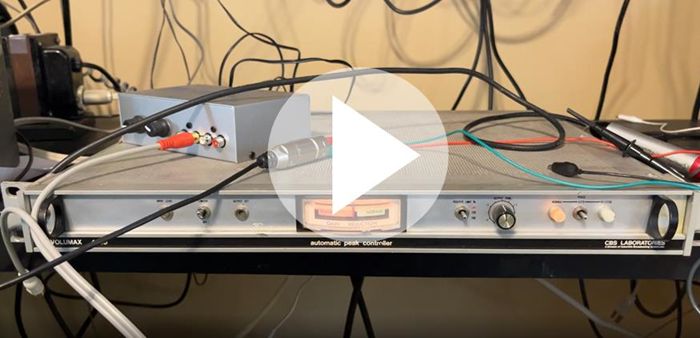
CBS Laboratories Volumax Model 4000 Automatic Peak Controller

This page describes the CBS Laboratories Volumax Model 4000 Automatic Peak Controller. This device was used by AM broadcasters to
prevent overmodulation. The Model 4000 Volumax combines a dual-action peak limiter with an automatic peak phaser to ensure the higher (positive) amplitude
peaks of program audio always modulate the carrier in the positive direction and negative peaks are precisely limited to 100 percent. When used with well-controlled
average audio input levels such as provided by the CBS laboratories Audimax, the Volumax supersedes all previous peak limiters in the prevention of carrier overmodulation by instantaneous
program peaks.
With conventional peak limiters, the broadcaster must reduce the program level so that the limiting of peaks will not be drastic enough to cause audio "pumping,"
thus lowering average power, or the pumping (that amounts to an audible distortion) has to be tolerated. Furthermore, because conventional limiters moderate
pumping by use of long recovery times, the intervals immediately following high program peaks waste modulation capability while the limiter recovers from reduced gain.
The Volumax circuitry solves these problems in a unique manner. Control is effected in two ways: time-varying AGC action, and microsecond-fast diode limiting.
The result is an even, pleasant sound plus the capability of transmitting program signals with high peak factor at twice the average program power level usually expected
when conventional limiters are used.
When the Volumax POSITIVE LIMIT switch is set for 100%, the time -varying AGC action responds equally to both positive and negative audio excursions, and the limiting action is
completely symmetric. If the 120% position is chosen, the Volumax AGC amplifier then requires positive peaks 1.2 times higher than the negative peaks to cause equal
amounts of limiting and, in addition, the "peak ceiling'' for positive program excursions is moved up so that the absolute limits have a ratio of 1.2 positive to 1.0 negative.
Finally, in the 300% position, the same negative "peak ceiling" is used as in the other two switch positions, while the AGC action responds only to negative peaks. In this case,
positive peaks are allowed to pass through the Volumax unit without limiting.
The input program signal also drives a polarity detector and a pause detector. These circuits sample the audio signal and determine from its assymetry and level whether the phase of the
signal needs to be reversed to allow higher peaks to produce positive modulation of the carrier and determine when that change should occur. The actual phase reversal is accomplished
by a clocked flip-flop. This flip-flop determines whether the program signal will pass through an inverting or non-inverting path in the Volumax unit. The operation of the automatic peak
phasing circuit is predicated on the fact that most speech audio is assymetric; in other words, the amplitude of one side may be as much as 10 db higher the other side. The Volumax unit
can sense assymetry factors as low as 1.6 db and turn them into useful positive supermodulation.
For a precise adjustment of the modulation level, a calibrated output attenuator allows the operator to vary the output level upward or downward by 2.5 db in 0. 5 db steps with
respect to a nominal OUTPUT SET level.
The Volumax unit is normally installed at the transmitter site immediately preceeding the transmitter audio input terminals. The Volumax is designed for peak protection and as such, it
should not be used for "gain riding" on a program line. Its use is predicated on uniform average volume unit (VU) input levels. Therefore, the use of an automatic level control such as the
CBS laboratories Audimax unit is recommended to be installed ahead of the Volumax in the audio line.
The Volumax unit has sufficient gain to correct for long-line and equalizer losses incurred when the transmitter is remotely located. Input levels as low as -24 dbm can be accommodated. If the input
level exceeds +18 dbm, the range of the input level control will not be sufficient and an audio attenuator at the audio input will be required.
The standard Volumax unit is wired for 600-ohm operation but can be changed for 150-ohm operation.
Below are specifications for the device.
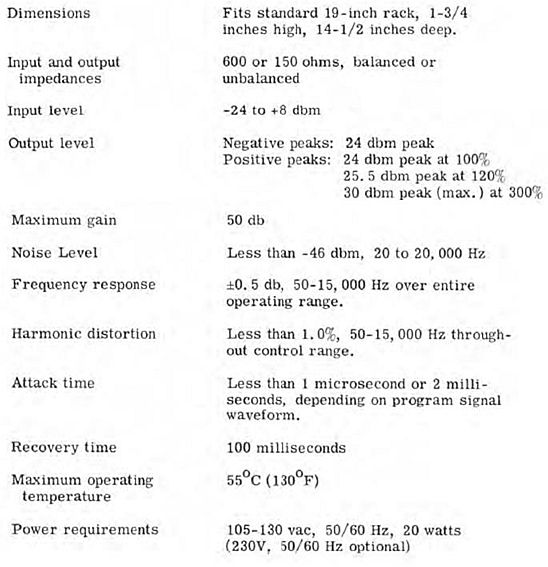
The Volumax unit incorporates a slimline design and requires only 1-3/4 inches of standard 19-inch rack height and only 13 -1/2 inches of depth behind the front panel. Its
solid-state circuitry is packaged in functional groups on three circuit boards, and has appropriate test points to support maintenance tests and troubleshooting. The entire
unit slides out of its rack mounted enclosure to permit easy bench service while providing maximum accessibility to all components. Front panel controls are conveniently arranged,
and those requiring infrequent use (e.g., the INPUT LEVEL and OUTPUT SET controls) are recessed screwdriver adjustments. A front panel meter indicates the relative degree of gain reduction.
The chassis removed from its rack mount is shown below.
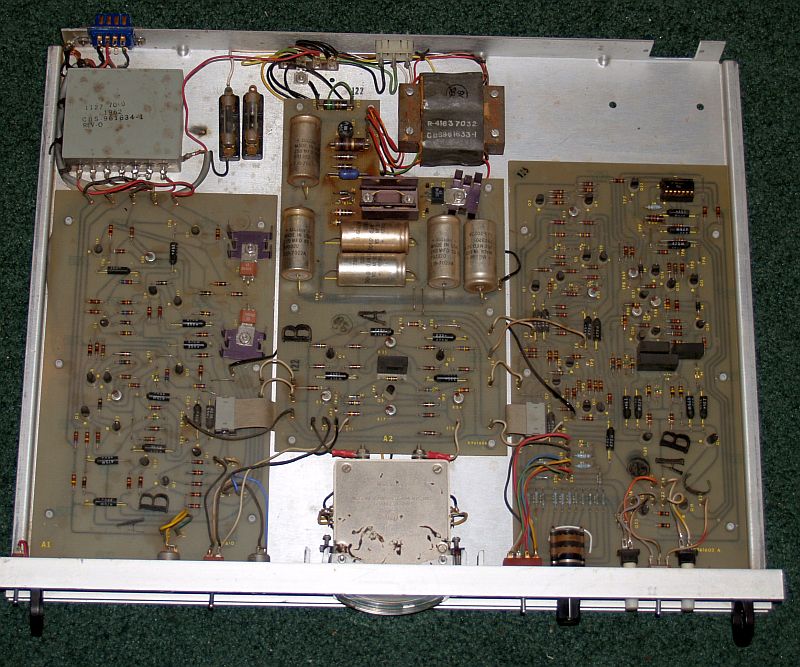

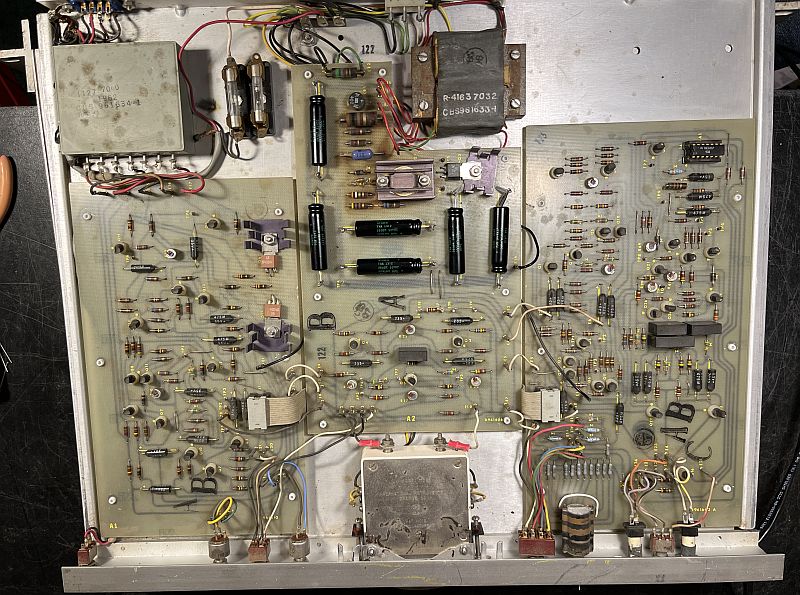
When I received this device, the electrolyte of a couple of the electrolytic capacitors on the power supply board had begun leaking out of the capacitors. However, the unit seemed to work as designed
without any noticable hum. I relaced all of the electrolytic capacitors on the power supply board as shown below.
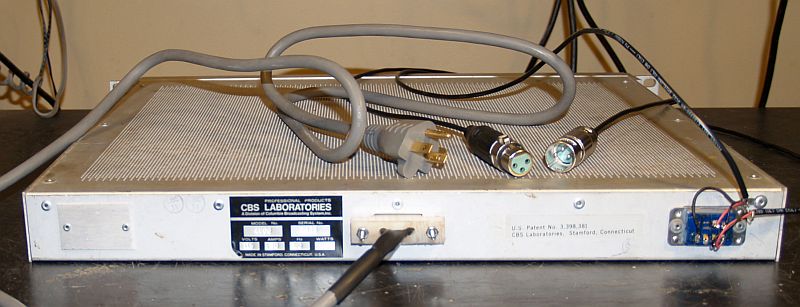
The unique power cord was not supplied with this unit. Therefore, I fabricated one from scratch. I used Molex part number 02-09-1117, standard 0.093", 1381 series, socket, crimp, tin-plated
contacts for the connector. I made the connector housing from 1/2 inch thick 6 in x 6 inch off-white nylon bar stock. I cut the nylon bar to size and drilled holes to accommodate the Molex sockets
and the connector mounting screws. I used a three-wire appliance replacement cord for the power cord. Below are pictures of the power cord connected to the unit.


Below is a picture of the unit showing the power cord and the audio connections.
The unit works well as intended. Click on the image below to see a video of the Volumax unit processing audio from a television program.