 |
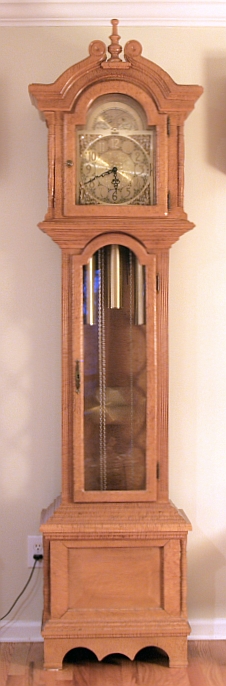
This is a Grandfather Clock that my uncle made for me in 1982. The clock stands about 7 feet tall and is made of curly maple wood. The clock has glass on three sides so you can see the clock movement and the pendulum. Note the lattice work behind the glass on the sides of the pendulum portion. The clock movement is made in Germany and chimes every 15 minutes and strikes the hour at the top of the hour. I have it set to play the Westminster chimes (Big Ben), but it can also be set to play Whittington, St, Michaels, or silent. The clock has a moon dial at the top that indicates the phases of the moon. The clock is driven by three weights - one weight each for the time keeping, the chimes, and the striking of the hour. Once I got the clock regulated, it keeps time very well. I have to wind it once per week. |

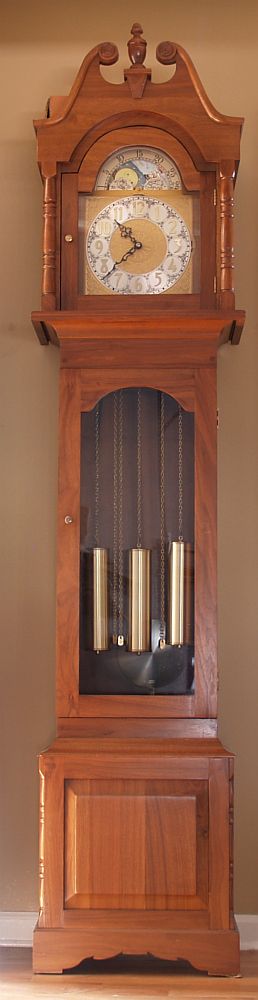
The picture above is of a Grandfather Clock that belonged to my parents. It was made by Alvin Sink, who lived in my home town. The clock has glass on both sides so you can see the clock movement.The clock movement is made in Germany and chimes every 15 minutes and strikes the hour at the top of the hour. I have it set to play the Westminster chimes (Big Ben), but it can also be set to play Whittington, St, Michaels, or silent. The clock has a colorful moon dial at the top that indicates the phases of the moon. The clock is driven by three weights - one weight each for the time keeping, the chimes, and the striking of the hour. Once I got the clock regulated, it keeps time very well. I have to wind it once per week.

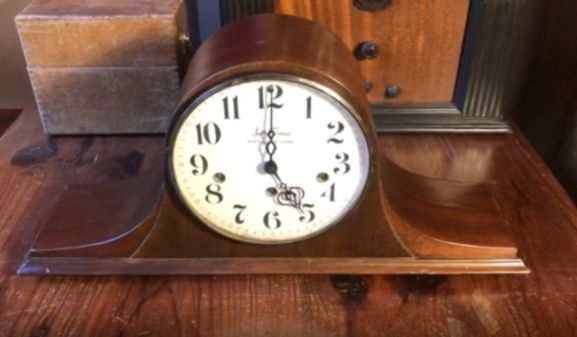
The picture above shows an antique tambour clock that I have. This mantle clock is made by Ingraham and it belonged to my grandparents. Note the inlaid lighter color wood below the dial. It double strikes the hour with two tones and single strikes with one tone on the half hour. This clock has a small pendulum and is spring powered - one spring for the clock and one spring for the striker. Access to the pendulum is through a door in the back of the clock. I have to wind this clock once per week. The two candlesticks on both sides of the clock came with the clock and are made of wood. The "Humpty Dumpty" egg on the right is made of wood and was made and painted by a lady from my hometown.

The picture above shows an antique Seth Thomas Medbury 5W Clock With Westminster Chime that I restored. This clock was purchased at an antique dealer where the clock was in an open-air large shed. The picture below shows the clock as purchased before I restored it.

As you can see, the clock case was dirty with paint specs and the glass over the dial was quite grungy. The picture below shows the back of the clock with the door open and the movement removed.
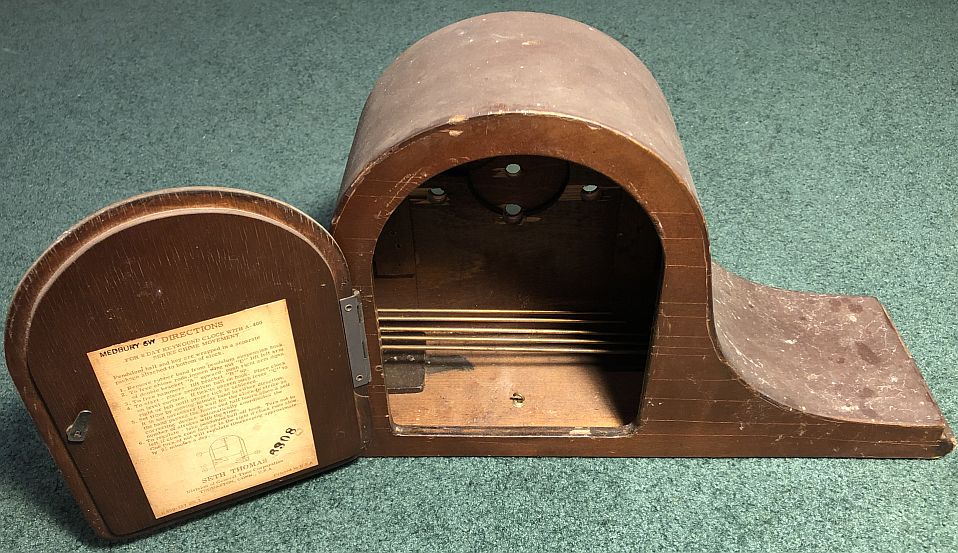
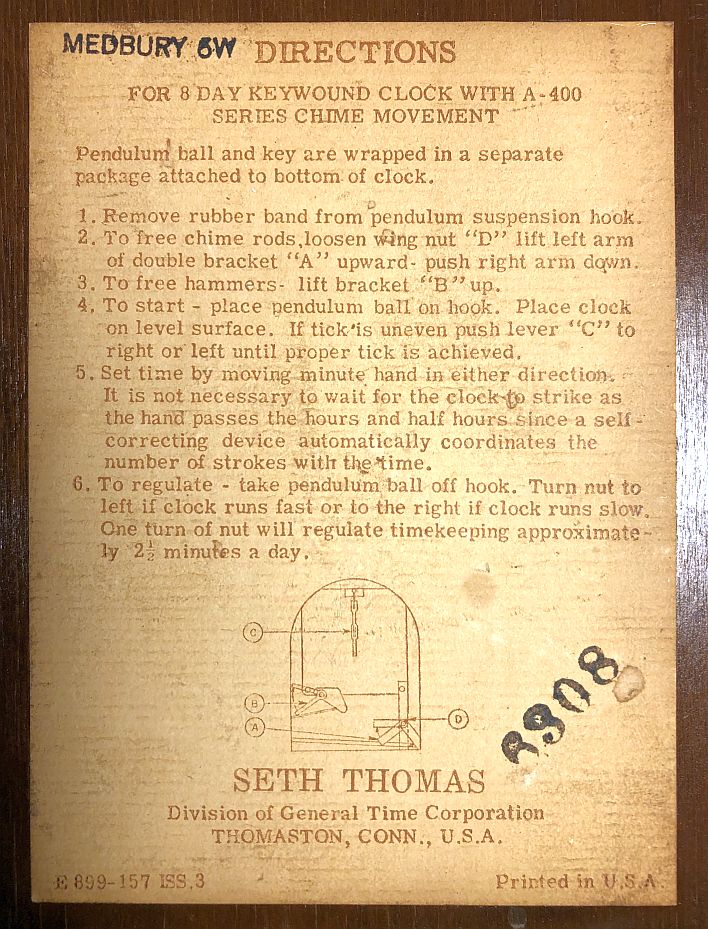
he picture below shows the directions for operating the clock. These directions are on the inside of the door.
To clean the movement, I placed the movement in water with dishwashing liquid. I let it sit for a few hours,then I rinsed it with warm water and used my air compressor to dry it.
The movement had rust on several of the gear shafts. The shaft with the fan wheel asociated with the hour strike was rusted in place on the movement back plate. The shaft eventualy broke at the back plate. I bored a small hole in thin brass shim stock and folded it over the back plate such that the remainder of the shaft would use that hole as a bushing. I epoxyed the brass to the back plate. The strike mechanism works well now.
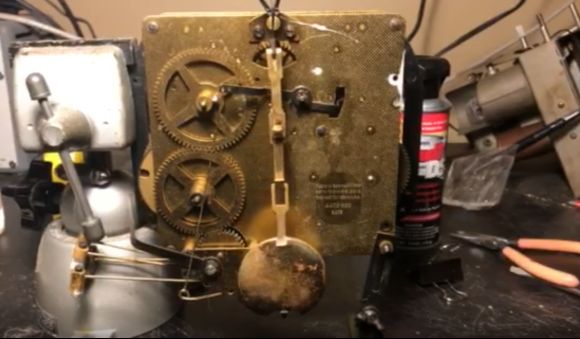
The timekeeping train and the Westminster chime train worked after cleaning and oiling. The movie below shows the pendulum swinging and the movement ticking on my workbench. Click on the picture to see it ticking.
The original dial with the smeared numbers could not be salvaged as the dial is painted onto the metal dial pan. I found a paper dial on line that had the correct Seth Thomas Arabic numerals. However, that dial was only 4.5 inches in diameter and I needed a 6.5 inch diameter dial. I scanned the 4.5 inch diameter dial and enlarged it to 6.5 inches using the Gimp image program. Then, I inserted the Seth Thomas logo and Westminster nomenclature from a picture of the original dial that I took with my cell phone. I also replaced the diamond hour marks of the purchased dial with the circle hour marks from the picture I took of the original dial. With some contrast adjustments and sharpening, the new dial turned out well. I printed the dial on card stock. I cut the dial out and mounted it to the dial pan using the three original hole grommets. I added a little contact cement to four places around the outside of the dial to ensure it would remain flat on the dial pan.
I cleaned the glass with soap and Windex. I used Formby's Restorer to remove the paint specs from the case and to remove the old finish to reveal the grain in the wood. I finished the case with semi-gloss tung oil. As seen in the first picture, the restoration turned out well. Below is a video of the clock striking. Click on the picture to hear it strike.
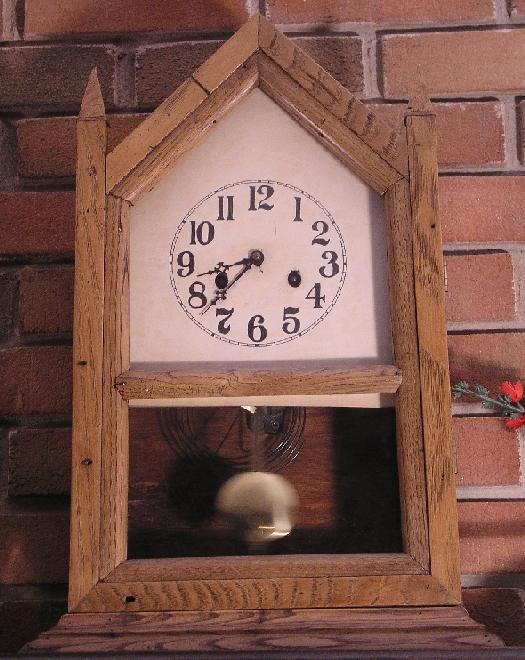
The picture above shows a mantle clock that my father made for me. The clock is made of wormy chestnut wood that was left over from the paneling in my parent's den and kitchen. The clock strikes the hour and once on the half hour. You can see the gong below the dial. The clock is spring powered with one spring driving the movement and the other driving the striker. I have to wind this clock once per week.
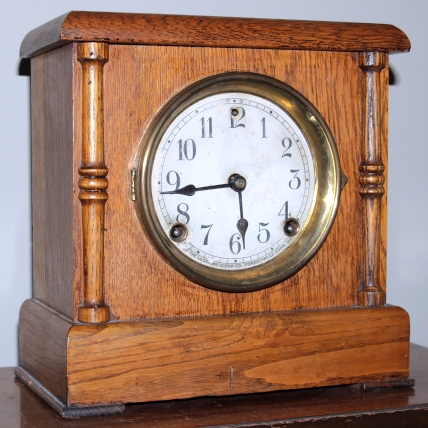
The picture above shows a mantle clock that belonged to my grand parents. The clock is made of oak and is an eight-day clock with a bell that strikes on the half-hour and a cathedral gong that strikes the hour. The clock was made by the Sessions Clock Company of Forestville, Connecticut.
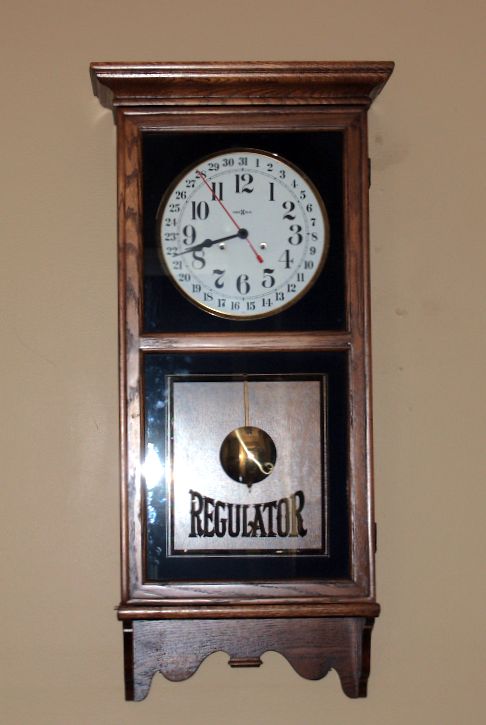
Th picture above shows a "Regulator" Clock I have. This is a replica of those clocks often seen long ago in schools and stores. In addition to keeping the time of day, this clock also displays the day of the month.
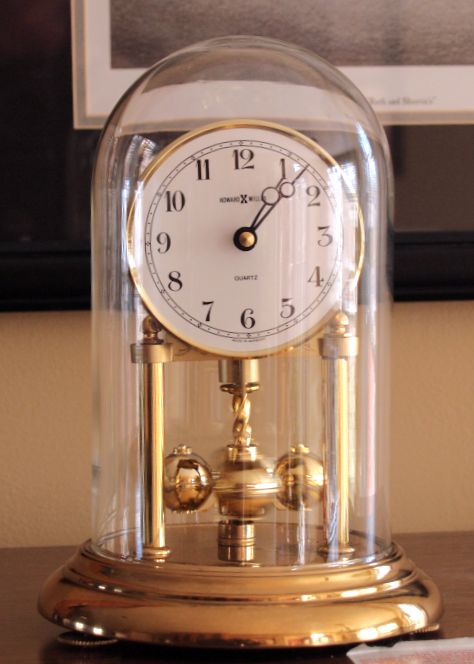
The picture above shows an "Anniversary Clock." This clock is a battery-operated replica of a so-called "Anniversary Clock". A real wind-up clock of this type kept time by twirling the weighted ball pendulum back a forth. The twisiting movement of the ball pundulum was the escape mechanism of this type of clock. In this this battery-operated clock, the twisting movement is only for looks - a crystal oscillator timebase keeps the time.

The picture above shows a 400-day "Anniversary Clock." This clock is a circa 1950 wind-up clock made in Germany. It requires winding only once per year, hence the name Anniversary Clock. This clock was manufactured by Konrad Mauch. This clock is a "Black Forest" model similar to the "Koma" version.
I purchased this clock at an antique dealer where the clock was in an open-air large shed. The clock has the original cut glass dome. However, the suspension spring was broken and the bottom block missing as is often the case. The broken suspension spring measured 0.0025 in thick. A replacement spring of that thickness made the clock run too slow. A Koma version requires and 0.0035 in thick spring and replacing the spring with one of that thickness made the clock run correctly. Below is a video of the clock running properly.

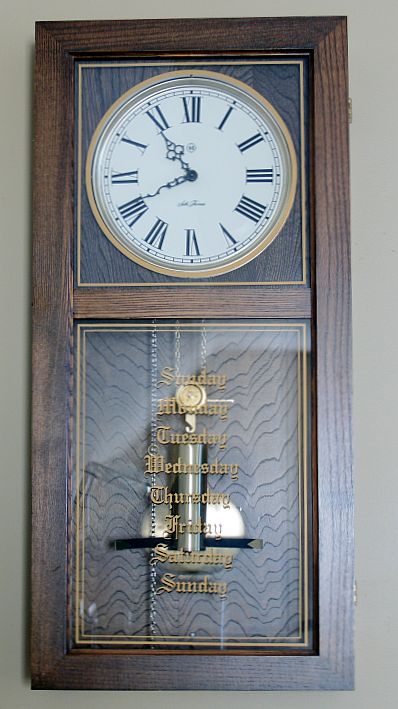
The picture above is of a wall-mounted clock that shows the day of the week. It does not chime and has a single weight to drive the clock movement.

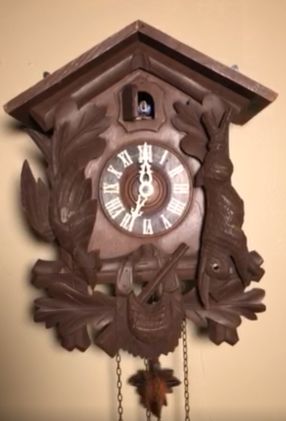
The picture above is a Schatz 8 day cuckoo clock with time and cuckoo (no music). This clock is a "hunting model" clock with a bird, a rabbit, a rifle, a pouch, maple leaves, including the maple leaf pendulum bob, and pine cone lead weights. The brass logo saying "Schatz 8 Day" that would be on the little door is mising. I believe this clock was manufactured by Jahresuhren Fabrik GmbH, A. Schatz & Sons, Triberg, Blackforest.
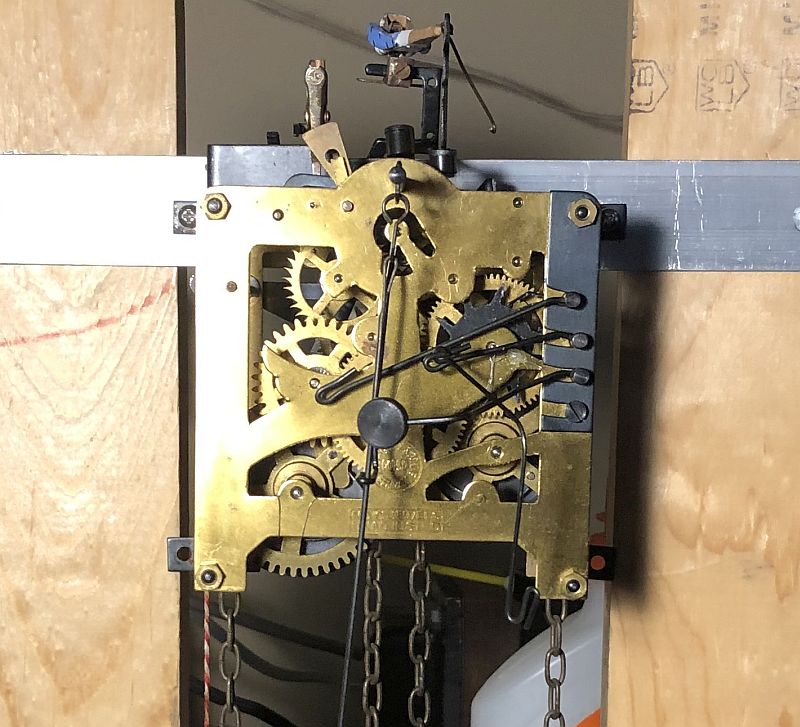
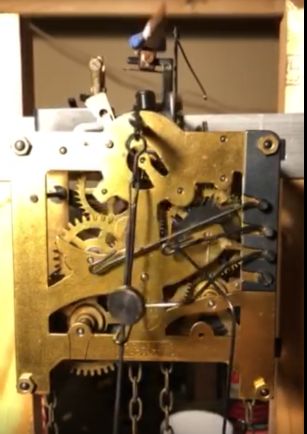
The picture below shows the movement on my test stand. This is one of the later-produced Schatz clocks as evidenced by the information on the back plate that reads: “Aug. Schatz & Sohne Germany” around the circle, and “KU 50” in the center.
I purchased this clock at an antique dealer where the clock was in an open-air large shed. The picture below shows the clock as I purchased it.
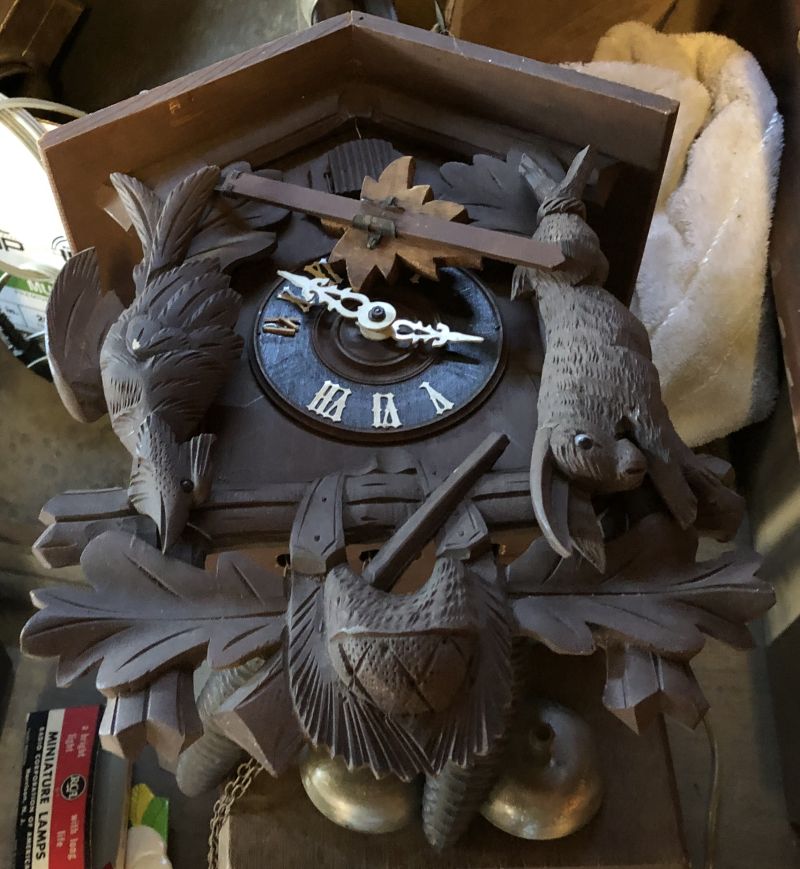
This clock has several issues:
1) Dial numerals were missing
2) One whistle was missing
3) The other whisle was present, but its bellows was missing
4) The wire link that connected the movement to the other whistle was missing
5) The back panel with the gong was missing
After cleaning the clock and after some time working with it, I did get it working. But, I could not get it to run at the correct speed - it would either run quite fast or not at all. In addition, I could not get it to strike with the loads of the two whisles unless I added additional weight to the pine cone weights.
The two pine cone weights that came with the clock both weighed 14.9 ounces. By gradually adding fishing weights to each, I finally got the clock to run properly - both in timekeeping and striking. I ended up with a 750 gram weight for the striking, and a 500 gram weight for the timekeeping. Appaently the weights that came with the clock were the wrong weights for this clock. I understand through some limited research, that this 8-day clock does have heavier weights than a 30-hour clock.
Click on the picture below to see the clock movement striking on my test stand.
I replaced the missing numerals. They were not the correct color, so I painted them with ivory-colored model paint. I made a back panel and purchased a gong. I purchased two replacement side-opening whistles along with a set of cuckoo clock metal wire links, etc. to replace the ones missing and to repair the little door hinges. I broke the original hour hand when attemping to reinstall it,so I had to purchase a replacement. After all of the repair activity, the clock works well and keeps good time.
Click on the picture below to see a movie of the clock striking.
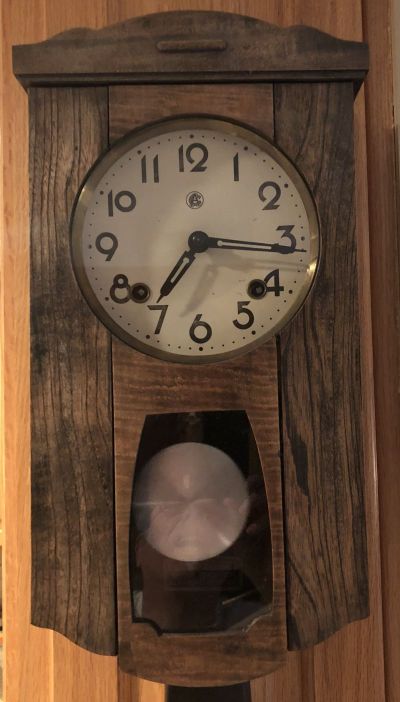
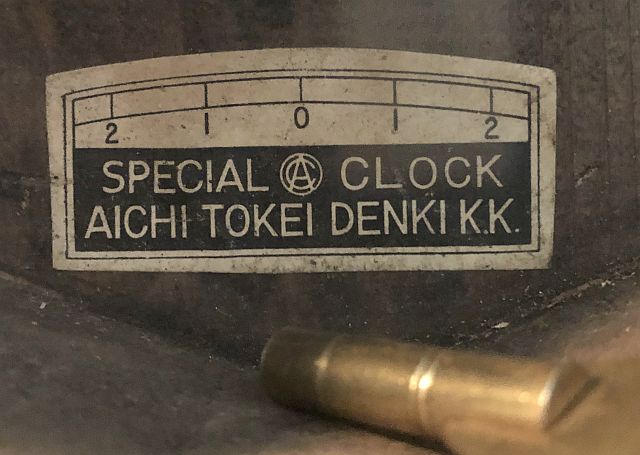
The picture above is a wall clock that I purchased at an estate sale. The clock was manufactured in Japan as evidenced by the label inside th clock as seen below. I understand "Tokei" in the company name refers to "clock" in Japanese.
The clock stikes only at the hour. This clock runs properly when I purchased it.