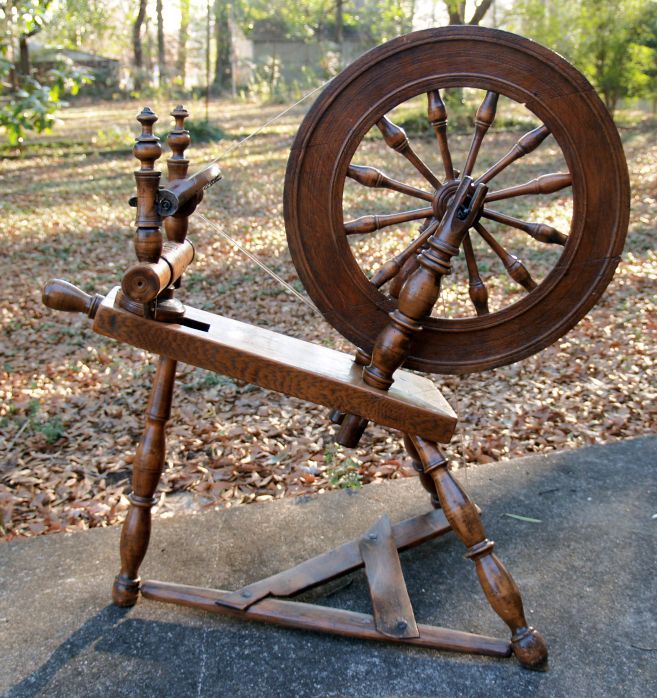
This is a flax wheel that belonged to my grandmother. This device is used to form wool or flax into yarn. The wool or cotton fibers are first cleansed of dust and straightened to form a cylindrical shape by two hand-held "scrapers" that look similar to ping-pong paddles with short bristles. The process is called "carding." I do not have the card paddles. The flax wheel is powered by a foot pedal (treadle) that is attached using a straight wood rod (footman) or rope to the axle of the wheel on one end. That end of the axel has an L-shaped crank that is broken off on my flax wheel, so the treadle will not turn the wheel. The wheel is 18 inches in diameter.
Below is a view showing the spindle.
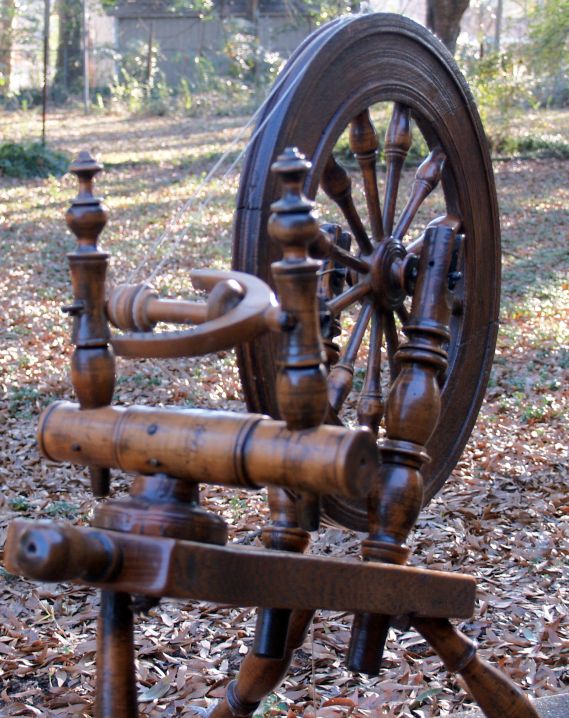
Note the spindle is powered by the wheel using two string drive bands. One powers the U-shaped arm (flyer)that has hooks in the two arms. The other belt powers the bobbin internal to the flyer. Because the diameter of the flyer pulley (flyer whorl) and bobbin are different, the flyer and bobbin spin at two slightly different rates.
The knob on the rear of the flax wheel allows tension of the drive bands by moving the spindle assembly backwards and forward.
The wool or flax is twisted by routing the fibers through one end of the spindle axle, over on arm of the flyer, through one of the loops on the arm and then onto the bobbin. As the spindle turns, the fibers are twisted and then collected on the bobbin.